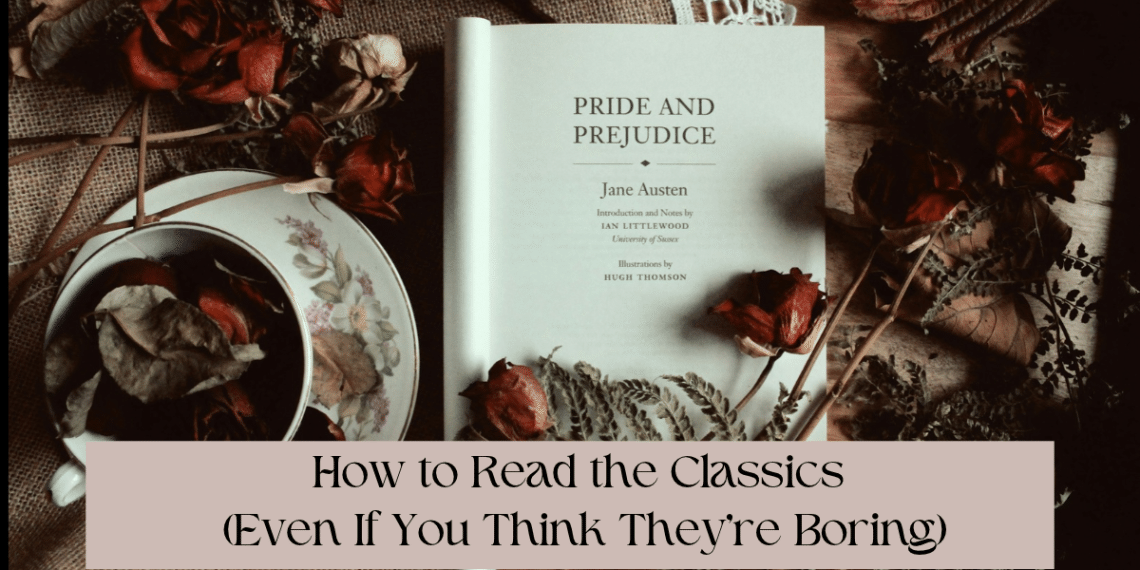
How to Read the Classics (Even If You Think They’re Boring)
Because great literature shouldn’t feel like homework!
Have you ever picked up a classic novel, read the first few pages, and thought, What in the world did I just read?
Maybe it was the old-fashioned language, the endless descriptions, or the fact that one sentence seemed to go on for an entire paragraph. Or perhaps you had flashbacks to high school English class, where reading the classics meant writing essays, memorizing quotes, and taking tests about symbolism you didn’t even know existed.
Trust me, I get it.
But here’s something I’ve learned as a reader: The classics aren’t just books we’re supposed to read. They’re stories that have stood the test of time for a reason.
And sometimes, all it takes is a different approach to discover just how wonderful they can be.
Whether you’re hoping to tackle Pride and Prejudice, finally finish Jane Eyre, or figure out why everyone keeps talking about Wuthering Heights, I’m sharing some practical tips for reading the classics without feeling overwhelmed.
1. Start With a Classic That Actually Interests You
Just because a book is considered a masterpiece doesn’t mean it has to be your masterpiece. One of the biggest mistakes readers make is starting with a classic simply because they think they should read it. Instead, think about the kinds of books you already enjoy.
Love romance? Try Pride and Prejudice by Jane Austen.
Enjoy mysteries? Pick up The Hound of the Baskervilles by Arthur Conan Doyle.
Prefer suspense and psychological drama? Rebecca by Daphne du Maurier might be right up your alley.
Love stories about strong, independent women? Give Little Women by Louisa May Alcott ( right now this one is free) or Jane Eyre by Charlotte Brontë a chance.
The secret is finding a classic that connects with your reading personality.
Reading should be an adventure, not a punishment.
2. Forget Everything You Learned About Required Reading
Remember those assigned books in school? The ones where you had to read three chapters, answer twenty questions, and explain what the curtains symbolized? Let’s leave that experience in the classroom. Reading classics as an adult is completely different because now you’re reading for yourself. You don’t have to analyze every metaphor. You don’t have to write a five-paragraph essay. And you certainly don’t have to understand every single sentence. Sometimes a story is simply meant to be enjoyed. Give yourself permission to read a classic the same way you would any other book.
3. Start Small Instead of Tackling a Giant Novel
If you’re new to classic literature, starting with an 800-page novel might not be the best idea. There are plenty of shorter classics that pack an incredible story into fewer pages.
Five Short Classics Perfect for Beginners
- The Great Gatsby by F. Scott Fitzgerald: A story about wealth, love, ambition, and the American Dream.
- Of Mice and Men by John Steinbeck: A powerful and heartbreaking story about friendship and dreams.
- A Christmas Carol by Charles Dickens: A timeless tale of redemption, generosity, and second chances.
- The Strange Case of Dr. Jekyll and Mr. Hyde by Robert Louis Stevenson: A fascinating exploration of human nature and the battle between good and evil.
- The Picture of Dorian Gray by Oscar Wilde: A dark, thought-provoking story about beauty, vanity, and morality.
Starting with something shorter can help build your confidence before you tackle longer works.
And there’s something incredibly satisfying about finishing a classic and thinking, Well, look at me! I did that!
4. Don’t Be Afraid to Use Audiobooks
Can we please stop acting like listening to a book doesn’t count as reading? Because it absolutely counts in my book! Audiobooks can be especially helpful when you’re diving into classic literature. Sometimes hearing the words spoken aloud makes the language easier to understand. A talented narrator can bring characters to life, clarify dialogue, and make complicated passages feel more natural. You can listen while folding laundry, taking a walk, cooking dinner, or relaxing with a cup of coffee. Another trick? Listen to the audiobook while following along with the physical book or Kindle edition. It’s like having someone read alongside you.
5. Read the Introduction—But Watch Out for Spoilers
Many classic editions include introductions that explain the author’s background, the historical setting, and why the book became important. These can be incredibly helpful. For example, understanding the social expectations placed on women during Jane Austen’s lifetime can completely change how you experience her novels. However, some introductions reveal major plot points. My suggestion? Read a brief, spoiler-free overview before starting the book, then save the detailed introduction for afterward. You’ll appreciate the story’s historical context without ruining the surprises.
6. Give Yourself Permission to Look Things Up
Here’s a little secret: You don’t have to pretend you understand everything. Classic novels often include unfamiliar words, historical references, outdated customs, and social rules that seem downright strange today. And that’s okay!
One of my favorite things about reading on a Kindle is the built-in dictionary. If I come across a word I don’t recognize, I can simply tap it to see the definition. No need to interrupt my reading to hunt down a dictionary. You can also look up historical events, clothing styles, locations, or cultural references that help you better understand the story. Just be careful when searching online because spoilers are everywhere.
7. Break the Book Into Manageable Pieces
One of the easiest ways to make a classic feel less intimidating is to stop looking at the entire book. Instead, focus on a few pages or chapters at a time.
Try reading:
- 10 pages every morning with your coffee.
- One chapter before bed.
- 20 minutes during your lunch break.
- A few pages each day alongside your regular reading.
You don’t have to finish a classic in a weekend. Some books are meant to be savored. And if it takes you an entire month to finish one? That’s perfectly fine. Reading isn’t a race, and there’s no trophy waiting for the person who finishes War and Peace the fastest.
8. Watch the Movie After Reading the Book
I know some readers have strong opinions about movie adaptations, but I love seeing how a story translates from page to screen. After finishing a classic, watching its movie or television adaptation can be a wonderful way to revisit the characters and setting.
Some great examples include:
- Pride and Prejudice
- Little Women
- Jane Eyre
- Emma
- Sense and Sensibility
- The Great Gatsby
You might notice details you missed while reading or discover that you imagined a character completely differently. And sometimes the adaptation makes you want to go back and reread the book. Just remember that movies often change or leave out parts of the original story.
9. Find a Reading Buddy or Join a Book Club
Some books are simply better when you have someone to discuss them with. Especially the classics! There are characters you’ll love, characters you’ll absolutely despise, and moments when you’ll want to shout, Why on earth would you do that? Having a reading buddy makes the experience more enjoyable. You can compare interpretations, discuss confusing passages, and celebrate finishing the book together. If you don’t have someone nearby who enjoys classics, look for online book clubs, reading challenges, or social media groups dedicated to classic literature. You might be surprised by how many people are discovering these stories for the first time.
10. Remember That Classics Were Once Contemporary Books
This is one of my favorite things to remember when reading older literature. Jane Austen wasn’t writing historical fiction about the Regency era. She was writing about the society around her. Charles Dickens wasn’t trying to create an intimidating literary masterpiece for future English students. He was telling stories about the people, struggles, and injustices of his time. These authors wrote about love, jealousy, family drama, heartbreak, ambition, money, betrayal, and hope.
Sound familiar? That’s because human nature hasn’t changed nearly as much as we think. The clothing, language, and social expectations might be different, but the emotions are incredibly relatable. And that, my friends, is what makes a classic timeless.
11. Don’t Be Afraid to Put a Classic Down
I’m going to say something that might make a few literature professors cringe.
You do not have to finish every classic you start.
There. I said it. Life is too short to spend every reading moment struggling through a book you genuinely dislike. Now, I do recommend giving classics a little more patience than your average contemporary novel. Sometimes the writing takes a while to get used to, and some stories have slower beginnings. But if you’ve given a book a fair chance and it still isn’t working for you, it’s okay to move on. Maybe you’ll return to it in five years and absolutely love it. Or maybe you won’t. Either way, it doesn’t make you any less of a reader.
12. Make Reading the Classics Feel Special
One of the best ways to build a reading habit is to turn it into something you look forward to. Light a candle. Grab your favorite blanket. Make a cup of tea or coffee. Find a cozy corner and settle in. Maybe you create a classics reading journal where you write down favorite quotes, memorable characters, and your thoughts about each book. You could even make a personal reading challenge to finish six classics in a year. The point is to make the experience enjoyable. Not another item on your never-ending to-do list.
My Beginner-Friendly Classics Reading List
If you’re ready to get started but aren’t sure which book to choose, here are ten classics worth considering.
| Book | Author |
|---|---|
| Pride and Prejudice | Jane Austen |
| Little Women | Louisa May Alcott |
| The Great Gatsby | F. Scott Fitzgerald |
| Jane Eyre | Charlotte Brontë |
| A Christmas Carol | Charles Dickens |
| The Secret Garden | Frances Hodgson Burnett |
| Anne of Green Gables | L. M. Montgomery |
| The Adventures of Sherlock Holmes | Arthur Conan Doyle |
| The Picture of Dorian Gray | Oscar Wilde |
| Frankenstein | Mary Shelley |
You don’t have to read them in order, and you certainly don’t have to love every single one.
Choose the story that speaks to you.
How to Read Classic Books for Free
Here’s another reason I love exploring classic literature: Many older books are available completely free! Because so many classics are in the public domain, you can often download them legally without spending a dime.
Some of my favorite places to look include:
Project Gutenberg: Visit gutenberg.org for thousands of free public-domain ebooks, including many popular classics.
Standard Ebooks: Visit standardebooks.org for beautifully formatted editions of public-domain books.
Libby: Check whether your local library offers classic ebooks and audiobooks through the Libby app.
Your local library: Don’t forget about good old-fashioned library shelves! Many libraries have wonderful classic literature collections.
Amazon Kindle: Search the Kindle Store for free public-domain editions of classics. Just double-check the price before downloading because not every edition is free.
A little frugal reading tip: Some newer editions contain copyrighted introductions, annotations, or translations even when the original story is in the public domain. That’s why prices can vary.
Final Thoughts: You Don’t Have to Be a Literary Expert to Love the Classics
If there’s one thing I hope you take away from this post, it’s that classic literature belongs to everyone. Not just English teachers. Not just literature majors. Not just people who can quote Shakespeare without looking it up. It belongs to the reader curled up on the couch with a cup of coffee, the busy mom sneaking in a chapter before bedtime, and the person who hasn’t picked up a classic since high school. It belongs to you. And who knows? That dusty old novel you’ve been avoiding might become one of your favorite books. So pick one up. Open the first page. Give it a chance. You might just discover that some of the best stories were written long before we were born.
Happy reading, my friends!
Now I want to hear from you! What’s one classic book you’ve always wanted to read but haven’t gotten around to yet? And is there a classic you read in school that you’d love to revisit as an adult? Share your thoughts in the comments!
Until next time, keep turning those pages and discovering new adventures, one book at a time.
— Melissa, Reading with Frugal Mom

You May Also Like

Literary Tourism: How Books Can Inspire Your Next Adventure

How Reading Helps Us Heal
