Living Between Two Worlds: The Space No One Really Prepares You For
There’s a strange feeling that comes with immigration that I don’t think you can fully understand until you’ve lived it. It’s not just about moving countries. It’s not just about packing bags, booking flights, and starting over somewhere new. It’s quieter than that. More internal. More constant.
It’s the feeling of living between two worlds… and not fully belonging to either one.
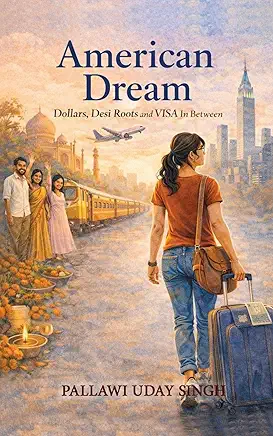
When I wrote The American Dream, I didn’t want to romanticize immigration. I wanted to show what it actually feels like when your life is split into “before” and “after”—and you’re the only one trying to connect both versions of yourself.
Because that’s what it is, really. A constant balancing act between who you were and who you are becoming. And some days, that balance feels steady. Other days, it doesn’t feel like balance at all. It feels like contradiction. Back home, everything is familiar in a way you don’t have to think about. You don’t question how you speak, how you move, how you exist in your environment. You just are.
Then you move somewhere new, and suddenly everything becomes intentional. Even simple things—ordering food, making conversation, understanding systems—take mental effort. And slowly, without even noticing, you start developing two versions of yourself. One that belongs to where you came from. And one that is trying to belong where you are. The funny thing is, neither version ever fully disappears. They just sit beside each other.
And that creates this ongoing internal dialogue that most people don’t see.
One of the biggest emotional shifts I’ve experienced—and seen others go through—is how identity changes in a new country. It’s not dramatic. It doesn’t happen overnight. It happens in small moments.
Like when you pause before speaking because you’re thinking about how your words will be received. Or when you catch yourself explaining things about your background that once felt unnecessary. Or when you start adjusting your personality slightly depending on where you are and who you’re speaking to. Over time, these small adjustments add up. And you start wondering—what part of me is still just me?
This is where relationships start to shift too. Not because people change intentionally, but because distance and adaptation quietly reshape connection. Some friendships deepen; others fade. Family relationships evolve because you are no longer fully present in the same physical or emotional space.
Even career choices start to look different. You begin making decisions not just based on passion, but based on practicality, stability, and what is possible in your new environment. It’s not necessarily limiting—it’s just different. More layered.
And then there’s the idea of the “American Dream.”
Before moving, it feels simple. A vision. A goal. A clear idea of opportunity.
But once you’re inside it, you realize it’s more complicated than that. It’s not a straight path. It’s a mix of opportunity and sacrifice that exist side by side. For every gain, there is an adjustment. For every opportunity, there is something you leave behind.
And no one really talks about that emotional trade-off enough.
One of the most overlooked parts of immigration is how much it changes your relationship with everyday systems, especially financial ones. Credit scores, banking systems, rental histories… these are things that many people grow up understanding without even thinking about them. But for immigrants, they are entirely new languages.
You arrive with financial responsibility, sometimes even financial success, from your home country, but none of it translates directly. You start from scratch in a system where credit defines access to almost everything.
And that creates a very specific kind of frustration. Because you’re not new to responsibility. You’re new to the system. And yet, you have to rebuild everything step by step. But here’s what I’ve come to realize through my own experience and through conversations with so many others navigating the same space.
Living between two worlds is not just about struggle. It’s also about expansion.
You develop a kind of awareness that only comes from being in-between. You learn to adapt. You learn to observe. You learn to carry multiple perspectives at once. And yes, it can feel disorienting at times. But it also builds powerful resilience. Not the loud kind. The everyday kind. The kind that shows up when you figure things out without being told how. The kind that grows in small wins, not big announcements.
In many ways, The American Dream stopped being just about a place for me. It became about this ongoing process of becoming. Of learning how to exist in that in-between space without rushing to resolve it. Because maybe living between two worlds isn’t something you fix.
Maybe it’s something you learn to understand. And maybe, over time, you realize that you don’t have to choose between them completely. You just have to learn how to carry both.
Pallawi Uday Singh is an author and storyteller whose book The American Dream explores the emotional, cultural, and financial realities of immigration. Her writing reflects lived experience, offering honest and relatable insights into identity, belonging, and life between two worlds.


You May Also Like

The Gift I Hope to Leave My Daughters Reflections inspired by The Pain Cave
Selves Making Stories Making Selves